The Market Is an Auction
Understanding the simple idea behind how I read the market — and what it looks like in real time.
What If the Stock Market Is Really Just an Auction?
Strip away the charts, the terminology, and the thousands of stocks moving every day, and the market becomes surprisingly simple. It’s an auction.
Every stock has buyers and sellers. Sellers are willing to part with shares at certain prices. Buyers are willing to pay certain prices for them. Price moves as those two sides continuously negotiate with each other. When sellers get more aggressive, price tends to move lower. When buyers get more aggressive, price can move higher.
That’s not the whole story — earnings, news, macro conditions and a hundred other things shape what a stock is actually worth. But this idea is the lens I use to read price itself, and it’s where RAV80 starts.
Every Auction Has Two Sides
Think about any normal auction. If nobody wants what’s being sold, the seller may have to accept a lower price. If several people suddenly want the same thing, they start competing for it, and the price gets pushed higher.
Financial markets run a version of that process constantly, across thousands of stocks, every second the market is open. My system is built to search for situations where a stock has been under selling pressure, but the data is beginning to suggest buyers may soon get more interested. I’m not trying to know with certainty what happens next — I’m trying to identify situations where the probability may be starting to shift.
That’s the central idea behind everything RAV80 does. But it gets more interesting once you realize there isn’t just one of these auctions running at a time.
The Same Stock Can Be Participating in Multiple Auctions at Once
There isn’t just one auction happening in a stock — there are several, running simultaneously, on different clocks:
- Intraday — what buyers and sellers are doing today
- Multi-day — a move developing over several sessions
- Swing — a move developing over several weeks
- Longer-term — a repricing that may unfold over months or years
Someone investing in a company for five years is participating in a very different auction than someone buying an option they plan to sell two days later. They’re looking at the same company, the same stock price — but time changes the trade.
Same stock. Different timeframe. Different auction.
Same market. Different clocks.
The Shorter the Clock, the More Timing Matters
Time doesn’t just change which auction you’re in — it changes how much room you have to be wrong.
A long-term investor can usually tolerate more movement and give a thesis more time to develop. A swing trader has less runway. An options trader is working against an expiration date. Someone trading same-day options may have only hours.
Imagine identifying the right direction but being early. For someone holding shares over months or years, being early may just require patience. For an options trader, being early can be expensive — the position has a clock built into it, and an option can expire worthless if price doesn’t get there in time. The shorter the auction I’m participating in, the more precise I need to be about when I enter it.
That’s the real reason RAV80 runs scans across different timeframes. It’s not about finding “the” setup — it’s about knowing which auction a setup belongs to, because that changes everything about how I’d approach it.
What a Fast Auction Looks Like
Here’s the concept compressed into just a few minutes.
On September 25, I was watching SPX. Price opened an upside auction trigger and then retraced. I entered slightly later than I would have preferred, but the auction was still intact.
At 11:59 AM I purchased four 7750 calls — one at $2.00 and three at $2.70, for an average cost of $2.53 per contract. Two minutes later I began exiting, selling three at approximately $5.27. Two minutes after that I exited the final contract at $7.30, for an average exit of $5.78 per contract.
Average cost to average exit works out to roughly +129% across all four contracts.
The entire trade — from entry to final exit — took approximately four minutes.
That’s a very short auction.
SPX · 30-second recap · trigger to exit
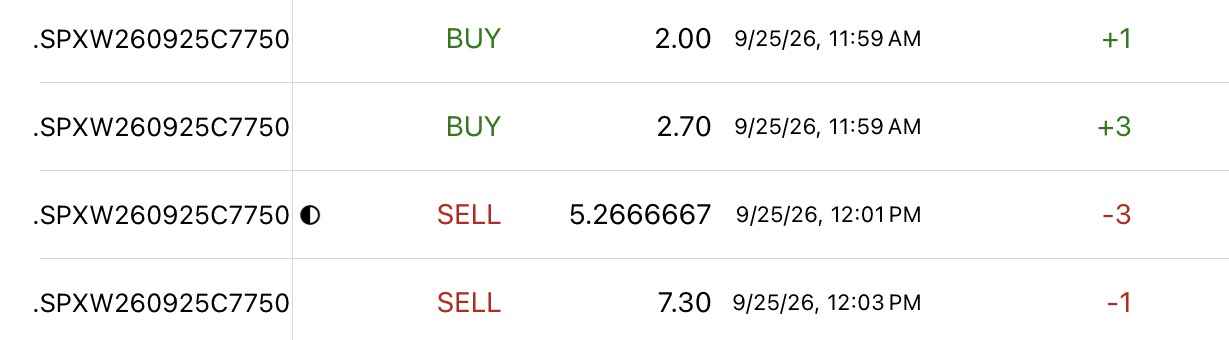
.SPXW260925C7750 · entry 11:59 AM · final exit 12:03 PM
The point isn’t the speed or the return. It’s the behavior.
Price opened an auction in one direction, retraced, and then continued that auction. On this timeframe, everything happened in minutes.
What I’m looking for with the larger RAV80 system is fundamentally the same behavior — just on a larger clock. A setup developing over days or weeks gives me more time to identify it, study it and decide how — or whether — I want to participate.
I’m Not Trying to Watch Everything. I’m Trying to Find the Auctions Worth Watching.
At any moment, thousands of auctions are taking place across the market. I don’t need to participate in all of them — most days, I don’t need to participate in more than a handful.
This is what that narrowing process can look like.
This Weekly Demand scan was captured on September 25, 2026. You don’t need to understand the scanner yet — pick one or two names and simply watch how they develop over the coming days and weeks.

The exercise isn’t to predict what happens next. Watch how price behaves and whether buyers begin to emerge. That’s where we’ll start connecting the concept of an auction to the actual data.
Data Doesn’t Create an Outcome. Decisions Do.
RAV80 reads the data, which points to a potential opportunity — but I still have to make a decision: entry, position size, risk, patience, exit. The outcome follows from that decision, not from the data alone.
This isn’t a completely different way of thinking than what I’ve spent my career doing. For more than 20 years I’ve worked with data to understand behavior, find opportunities and improve outcomes for businesses. RAV80 asks the market the same three questions: What is the data telling me? Where might the opportunity be? And what decision gives me an appropriate way to participate?
NKE
NKE previously appeared in my higher-timeframe demand work and remains a position I’m watching. Price is still consolidating, so there isn’t a conclusion to draw yet.
Because I’m holding shares rather than short-dated options, I have something the SPX trade didn’t give me: time.
That makes it useful to watch as this larger auction develops. I’ll continue sharing what the data shows along the way.
The Goal Isn’t to Predict Every Move
I don’t believe successful trading requires predicting every move in the market. I’m much more interested in narrowing the field.
Which auctions are worth watching? Where might the balance between buyers and sellers be changing? How much time does the idea need? What would make me participate — and what would make me walk away?
Those are the questions RAV80 is built to help me answer. Sometimes the answer leads to a trade. Sometimes the best decision is to wait. And sometimes the data tells me the original idea was wrong.
That’s part of the auction too.